
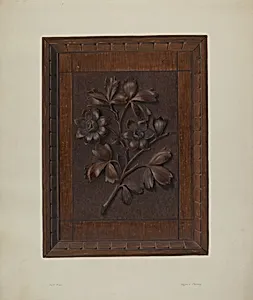
Carved Wood Panel
1935/1942
Medium
watercolor, graphite, and goauche on paper
Dimensions
overall: 48.3 x 40.5 cm (19 x 15 15/16 in.)
Classification
Index of American Design
Department
CG-W
Museum
National Gallery of Art, Washington, D.C.
Credit
Index of American Design
Accession Number
1943.8.12789
Rights
Public Domain
Art Historical Context
Behold the *Carved Wood Panel*, captivating rendering by artist Clyde L. Cheney, created between 1935 and 1942. This delicate watercolor, graphite, andache work on paper measures 48.3 x 40.5 cm and captures the intricate details of an American carved wood panel with remarkable precision. Cheney's skilled hand brings to life the textures and forms of traditional woodworking, transforming a three-dimensional craft into a vibrant, two-dimensional study. This piece is a gem from the Index of American Design, a ambitious Works Progress Administration (WPA) project during the Great Depression. Launched in 1935, the Index employed artists across the U.S. to document everyday American folk art, crafts, and design through over 15,000 such renderings. Housed in the National Gallery of Art's collection, it preserves vanishing traditions, highlighting regional craftsmanship and cultural heritage at a time when economic hardship threatened their survival. Cheney's artwork exemplifies the Index's mission: to celebrate America's artistic legacy with technical mastery. The gouache and watercolor techniques lend luminous depth and realism, making the carved motifs pop as if freshly hewn. For visitors, it's a window into 18th- or 19th-century vernacular design, reminding us of the ingenuity woven into everyday objects.
About the Artist
Clyde L. Cheney · 1895–1968
Clyde L. Cheney is an artist about whom little is currently known. No dates of birth or death have been established, and his nationality and artistic training are not documented in surviving historical records. With nearly fifty works attributed to him in institutional collections, Cheney's output points to an active career. The middle initial suggests a deliberate professional identity, but corr...