
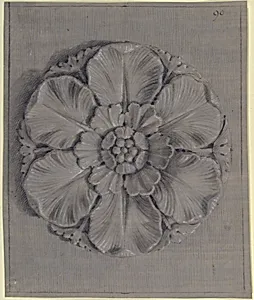
Design for a Rosette Relief
ca. 1825–50
Medium
Graphite, black chalk, heightened with white; framing lines in black chalk
Dimensions
sheet: 9 5/16 x 7 11/16 in. (23.6 x 19.5 cm)
Classification
Drawings
Department
Drawings and Prints
Museum
Metropolitan Museum of Art, New York, NY
Credit
Gift of Regina Slatkin, 1963
Accession Number
63.712.15
Rights
Public Domain
Tags
Art Historical Context
This delicate *Design for a Rosette*, created by an anonymous French artist 1825–50, captures the elegance of 19th-century decorative arts. Rendered on a modest sheet measuring 9 5/16 x 7 11/16 inches, it sketches a floral rosette—a motif inspired by blooming flowers, often used in architecture, furniture or ornamental sculpture. Such designs were essential preparatory works for relief carvings, where raised elements create shadow and depth, evoking the opulent interiors of the Restoration and July Monarchy eras in France. The artist employed graphite and black chalk for precise lines and shading, heightened with white chalk to model light and volume, mimicking the three-dimensionality of a finished relief. Framing lines in black chalk suggest it was intended for reproduction or scaling. This mixed-media technique, common in French ateliers, allowed draftsmen to convey texture and form vividly, bridging drawing and sculpture. Housed in the Metropolitan Museum of Art's Drawings and Prints department (gift of Regina Slatkin, 1963), this anonymous gem highlights the unsung craft of ornamental design during a time when floral motifs symbolized renewal and beauty amid France's cultural revival. Visitors will appreciate its intricate detail, a window into the meticulous world of 19th-century artisans.
About the Artist
Anonymous, French, 19th century · 1800–1900
**Anonymous, French, 19th Century (ca. 1800–1900)** The artist cataloged as Anonymous, French, 19th century embodies the enigmatic yet essential contributions of unidentified creators to France's vibrant 19th-century art world. Active roughly between 1800 and 1900, this figure—or potentially collective workshop—produced a diverse array of works amid the nation's transition from Neoclassicism thro...