
Carving
Unknown Artist
9th–14th century
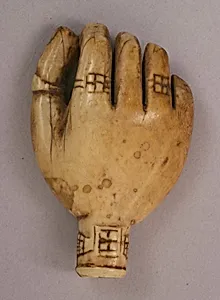
Medium
Ivory; incised and painted
Dimensions
W. 1 1/8 in. (2.9 cm) L. 1 3/4 in. (4.4 cm) D. 9/16 in. (1.4 cm)
Classification
Ivories and Bone
Department
Islamic Art
Museum
Metropolitan Museum of Art, New York, NY
Credit
Purchase, 1886
Accession Number
86.11.258
Rights
Public Domain
Tags
Art Historical Context
This exquisite ivory carving, hailing from the Islamic world between the 9th and 14th centuries, captures the mastery of miniature artistry in a remarkably small form—measuring just 1¾ inches long, 1⅛ inches wide, and 9/16 inches deep. Crafted from elephant ivory, it was meticulously incised with fine lines to create intricate details, then enhanced with paint for vibrant color and depth. Such techniques were hallmarks of Islamic ivories, prized for their portability and refinement, often adorning personal objects like handles, boxes, or amulets. Featured in the Metropolitan Museum of Art's Islamic Art Department (purchased in 1886), this piece reflects a golden era of craftsmanship across regions from Spain to Central Asia. The tag "Hands" suggests it depicts or symbolizes hands, possibly evoking themes of blessing, protection, or gesture in daily life and ritual—common motifs in Islamic decorative arts. Its survival speaks to the enduring allure of these tiny treasures, which blended functionality with spiritual symbolism, inviting us to marvel at the skill of an unknown artist who transformed raw ivory into a cultural gem.