
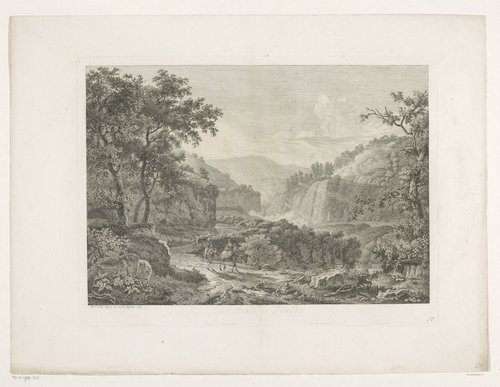
Cascatella di Tivoli
Medium
etching
Dimensions
372; 275
Rights
Public Domain
About this artwork
Schenking van de heer Burger
Art Historical Context
Albert Christoph Dies’s *Cascatella di Tivoli* captures the celebrated waterfall near Rome, a site that drew countless eighteenth-century travelers on the Grand Tour. Created in 1792 while Dies lived in Italy, the etching records the dramatic cascade with careful attention to light, mist, and rocky terrain—qualities that made Tivoli a favorite subject for artists seeking to convey nature’s sublime power. As an etching, the work reflects the period’s growing interest in reproductive printmaking. The medium allowed artists to distribute views of famous Italian landscapes to collectors across Europe, spreading both aesthetic appreciation and topographical knowledge. Dies’s precise line work and tonal gradations translate the dynamic movement of water into a static yet evocative image suited to intimate viewing. Measuring roughly 27 by 37 centimeters, the print entered the museum collection as a generous gift from Mr. Burger. Today it offers visitors a window onto late-eighteenth-century tastes for Italian scenery and the enduring appeal of Tivoli’s natural wonders.
About the Artist
Albert Christoph Dies · 1755–1822
Albert Christoph Dies (1755–1822) was a German painter and writer who spent a significant portion of his career in Italy, working in the landscape tradition that drew so many Northern European artists to Rome during the late eighteenth century. Born in Hanover, Dies trained in the artistic milieu of the time and eventually made his way to Rome, where he became part of the community of German-speak...