
Case
Unknown Artist
16th century
Medium
Tooled leather (cuir bouilli) over wood core
Dimensions
Overall (confirmed): 5 5/8 × 3 1/4 × 3 1/4 in. (14.3 × 8.3 × 8.3 cm)
Classification
Natural Substances-Leatherwork
Culture
Italian
Department
European Sculpture and Decorative Arts
Museum
Metropolitan Museum of Art, New York, NY
Credit
Gift of Alastair Bradley Martin, 1949
Accession Number
49.61.3a, b
Rights
Public Domain
Tags
Art Historical Context
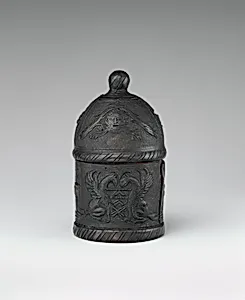
This exquisite 16th-century Italian, crafted by an unknown artist, exemplifies the mastery of everyday luxury objects. Measuring a compact 5⅝ × 3¼ × 3¼ inches, it features a wood core encased in tooled cuir bouilli—a hardened leather achieved by boiling it in water or wax to make it pliable for molding and embossing. Adorned with griffins, the mythical beasts symbolizing strength and guardianship, the case likely served as a protective container for valuables like mirrors, jewelry, or writing instruments, blending utility with artistic flair. The technique of cuir bouilli was prized in Renaissance Italy for its durability and versatility, allowing artisans to create intricate relief designs that mimicked more precious materials like metal or ivory without the prohibitive cost. Popular in both secular and ecclesiastical contexts, such leatherwork highlighted Italy's innovative decorative arts, bridging sculpture and craft. Griffins, drawn from classical mythology and heraldry, evoked the era's revival of ancient motifs, underscoring themes of power and protection. Today, this rare survivor graces the Metropolitan Museum of Art's European Sculpture and Decorative Arts collection, a generous 1949 gift from Alastair Bradley Martin. It invites us to appreciate how Renaissance craftsmen elevated humble materials into objects of enduring beauty and cultural resonance.