
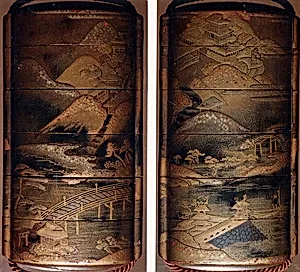
Case (Inrō) with Design of Buildings in Mountain Landscape
Unknown Artist
18th century
Medium
Lacquer, fundame, gold, silver and black hiramakie, nashiji, togidashi and kirigane; Interior: nashiji and fundame
Dimensions
H. 3 1/4 in. (8.3 cm); W. 1 3/4 in. (4.4 cm); D. 1 in. (2.6 cm)
Classification
Inrō
Culture & Period
Japan · Edo period (1615–1868)
Department
Asian Art
Museum
Metropolitan Museum of Art, New York, NY
Credit
Bequest of Stephen Whitney Phoenix, 1881
Accession Number
81.1.322
Rights
Public Domain
Tags
Art Historical Context
This exquisite 18th-century *inrō*, a compact lacquer case from Japan's Edo period (16151868), served as a portable container for medicines, seals, tobacco, suspended from a belt via a netsuke and cords. Worn by samurai, merchants, and elites, these diminutive treasures (just 3¼ inches tall) reflected the era's prosperity and refined craftsmanship, blending functionality with artistry in everyday life. The exterior features a serene mountain landscape dotted with buildings, bridges, men, and boats, rendered in sophisticated lacquer techniques. Gold and silver *hiramakie* (flat sprinkled designs) create shimmering depth, while *nashiji* grounds mimic pear skin texture, *togidashi* burnishing reveals layered motifs, and *kirigane* cut-foils add sparkling highlights. The interior's *nashiji* and *fundame* (gold-powder base) offer a luxurious contrast, showcasing the meticulous skill of anonymous Edo lacquer masters. Housed in the Metropolitan Museum of Art thanks to the 1881 bequest of Stephen Whitney Phoenix, this *inrō* embodies Japan's golden age of *urushi-e* lacquerware, where nature and human activity harmonize in miniature splendor—a testament to the culture's love for beauty in the practical.