
Case (Inrō) with Design of Thatched Building in Hilly Landscape with Trees and Waves with Nestuke of Thatched Building in a Landscape
Unknown Artist
second half 18th century
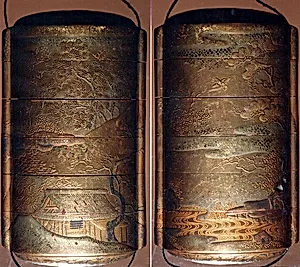
Medium
Lacquered wood with gold, silver maki-e, cut-out gold foil
Dimensions
H. 3 7/16 in. (8.8 cm); W. 1 7/8 in. (4.8 cm); D. 1 5/16 in. (3.4 cm)
Classification
Inrō
Culture & Period
Japan · Edo period (1615–1868)
Department
Asian Art
Museum
Metropolitan Museum of Art, New York, NY
Credit
Bequest of Stephen Whitney Phoenix, 1881
Accession Number
81.1.304
Rights
Public Domain
Tags
Art Historical Context
This exquisite *inrō* (lacquer case) from Japan's Edo period (1615–1868), to the second half of 18th century, the era's mastery of lacquerware craftsmanship. Worn suspended from a kimono sash via silk cords and secured by its matching netsuke toggle, the inrō served as a practical yet elegant container for medicines, seals, or tobacco, reflecting the refined tastes of samurai, merchants, and townsfolk during a time of peace and cultural flourishing. The case, crafted from wood and adorned with intricate maki-e—gold and silver powders sprinkled into wet lacquer—features a serene hilly landscape with a thatched building, swaying trees, and rippling waves. Cut-out gold foil adds shimmering depth, capturing nature's harmony in miniature scale (just 3 7/16 inches tall). The netsuke echoes this idyllic scene, showcasing the Japanese aesthetic of *wabi-sabi*—beauty in simplicity and impermanence—while tags hint at birds animating the vista. Housed in the Metropolitan Museum of Art's Asian Art Department through the 1881 bequest of Stephen Whitney Phoenix, this anonymous artwork highlights Edo Japan's exportable luxury arts, blending utility with poetic storytelling for everyday wear. Visitors, peer closely to appreciate the luminous details that once dangled at a wearer's waist!