
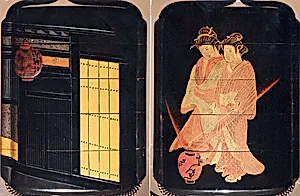
Case (Inrō) with Painting of Courtesan at Night (obverse); House Gate (reverse)
19th century
Medium
Roiro (waxen) lacquer with sprinkled hiramkie lacquer and togidashi sprinkled and polished lacquer; Interior: nashiji and fundame; Ojime: silver shibuichi lacquer bead decorated with design of castle grounds; Netsuke: carved wooden sleeping goose
Dimensions
2 11/16 x 2 1/16 x 15/16 in. (6.8 x 5.3 x 2.4 cm)
Classification
Inrō
Culture & Period
Japan · Edo period (1615–1868)
Department
Asian Art
Museum
Metropolitan Museum of Art, New York, NY
Credit
The Howard Mansfield Collection, Purchase, Rogers Fund, 1936
Accession Number
36.100.250
Rights
Public Domain
Tags
Art Historical Context
This exquisite *inrō* (lacquered case), crafted by Shibata Zeshin in 19th-century Japan during the Edo period (1615–1868), exemplifies the pinnacle of lacquer artistry. *Inrō* were medicine or accessory cases worn suspended from the sash of a kimono by samurai, merchants, and elites, secured with an *ojime* bead and *netsuke*. Zeshin, a master innovator, elevated lacquerware to rival painting, blending realism with technical virtuosity. Here, the compact case (just under 3 inches tall) features a roiro (waxen black) lacquer ground adorned with intricate sprinkled *hiramkie* and polished *togidashi* techniques on the exterior, while the interior gleams with shimmering *nashiji* gold flecks over *fundame* base layers. The obverse depicts a courtesan at night, illuminated by lanterns—a nod to the vibrant *ukiyo-e* world of pleasure quarters—while the reverse shows a serene house gate, evoking quiet domesticity. The silver-shibuichi *ojime* bead bears a castle grounds motif, and the wooden *netsuke* portrays a charming sleeping goose, adding whimsy to functionality. Zeshin's sprinkled and polished effects create luminous depth, mimicking moonlight and texture with astonishing precision. Housed in the Metropolitan Museum of Art from The Howard Mansfield Collection, this *inrō* highlights Edo Japan's obsession with refined craftsmanship, where everyday objects became canvases for cultural storytelling and social display. A testament to Zeshin's legacy, it invites us to appreciate the hidden artistry in miniature.
About the Artist
Shibata Zeshin · 1807–1891
Japanese, 1807–1891