
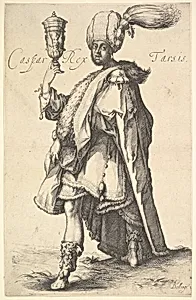
Caspar, after the "Three Magi" series by Jacques Bellange
Medium
Etching
Dimensions
sheet: 11 5/16 x 7 5/16 in. (28.7 x 18.5 cm)
Classification
Prints
Department
Drawings and Prints
Museum
Metropolitan Museum of Art, New York, NY
Credit
Bequest of Phyllis Massar, 2011
Accession Number
2012.136.9
Rights
Public Domain
Tags
Art Historical Context
Jacques Bellange's *Caspar, after the "Three Magi series* is a striking etching that captures one of the biblical Wise Men, Caspar, in a portrait-like pose. As a master printmaker from early 17th-century Lorraine, France, Bellange was renowned for his intricate etchings depicting religious subjects with Mannerist flair—elongated figures, dramatic expressions, and richly detailed costumes. This work, part of his celebrated "Three Magi" series portrays Caspar, traditionally the youngest of the Magi who brought myrrh to the Christ child, symbolizing his mortality and devotion in Christian iconography. Etching allowed Bellange to achieve fine, expressive lines and tonal depth on a modest sheet measuring 11 5/16 x 7 5/16 inches (28.7 x 18.5 cm). His technique, blending delicate cross-hatching with bold contours, made his prints highly prized by collectors during the Baroque era and beyond, influencing later engravers. Though the exact date is unknown, Bellange's output from around 1600–1616 reflects the vibrant print culture of Nancy, bridging Northern Renaissance precision with Italianate elegance. Today, this poignant portrait resides in the Metropolitan Museum of Art's Drawings and Prints department, thanks to the 2011 bequest of Phyllis Massar. It invites visitors to ponder the Magi's timeless journey, blending historical artistry with spiritual resonance.
About the Artist
Jacques Bellange · 1570–1616
Jacques Bellange (c. 1575–1616) was a French artist and printmaker active in the independent Duchy of Lorraine, now part of France. Believed to have been born in the Bassigny region south of Nancy, his early life and training remain sparsely documented, with no records of specific teachers or mentors. He first appears in historical records in 1595 at La Mothe, where he took on an apprentice, sugge...