
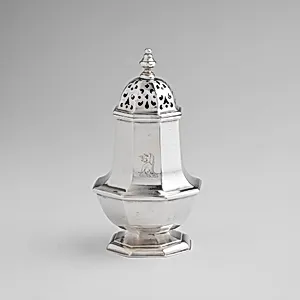
Caster
ca. 1735
Medium
Silver
Dimensions
Overall: 4 7/8 x 2 11/16 in. (12.4 x 6.8 cm); 5 oz. 4 dwt. (162.1 g) Foot: Diam. 2 1/4 in. (5.7 cm) Lip: Diam. 1 3/4 in. (4.4 cm) Body: H. 3 3/8 in. (8.6 cm); 4 oz. 4 dwt. (131.3 g) Cover: H. 1 7/8 in. (4.8 cm); 1 oz. (30.8 g)
Classification
Caster
Culture
American
Department
The American Wing
Museum
Metropolitan Museum of Art, New York, NY
Credit
Rogers Fund, 1948
Accession Number
48.152a, b
Rights
Public Domain
Art Historical Context
This elegant silver caster, crafted around 1735 by Boston silversmith Knight Leverett, exemplifies the refined tableware of colonial America. Standing just under five inches tall, the vessel was designed to dispense salt, sugar, or spices through its pierced cover, blending practicality with decorative appeal. Its modest yet graceful form—featuring a baluster-shaped body and simple foot—reflects the early Georgian taste that shaped American silverwork during this period. As a product of the American Wing’s collection, the piece highlights silver’s role as both functional object and status symbol in 18th-century households. Leverett’s careful craftsmanship, evident in the balanced proportions and smooth surfaces, demonstrates the technical skill of colonial artisans who often trained in English traditions while adapting them to local tastes and materials. Acquired by the Metropolitan Museum in 1948 through the Rogers Fund, this caster offers visitors a tangible connection to early American domestic life and the enduring artistry of silver as a medium of elegance and utility.