
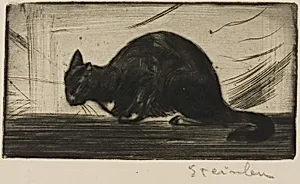
Cat Arching Its Back
Medium
Drypoint from a zinc plate on ivory laid paper
Dimensions
Image/plate: 7.6 × 14.1 cm (3 × 5 9/16 in.); Sheet: 22.2 × 30.6 cm (8 3/4 × 12 1/16 in.)
Classification
drypoint
Department
Prints and Drawings
Museum
Art Institute of Chicago
Accession Number
49629
Rights
Public Domain
Art Historical Context
In the late 19th century, Swiss-born French artist Théophile-Alexandre Stein captured the whimsical spirit of Parisian life through his masterful prints, and *Cat Arching Its Back (1898) exemplifies his enduring fascination with felines. This intimate drypoint etching on ivory laid paper depicts a cat in a classic arched pose—poised, alert, and full of personality—rendered with delicate precision. Measuring just 7.6 × 14.1 cm, the image invites viewers to lean in close, evoking the quiet charm of everyday encounters. Steinlen, a key figure in the Belle Époque poster art scene and illustrator for the famous Chat Noir cabaret, excelled in printmaking techniques like drypoint, where a sharp tool scratches directly into a zinc plate, raising a soft burr that produces rich, velvety lines. This method allowed him to convey the cat's fur texture and dynamic tension with remarkable sensitivity, blending realism and expressiveness. Zinc plates, less common than copper, offered finer detail for such small-scale works, highlighting Steinlen's technical innovation. Housed in the Art Institute of Chicago's Prints and Drawings department, this piece reflects the era's growing appreciation for animal subjects as symbols of independence and mystery. Steinlen's cats, beloved by collectors, remind us of art's power to immortalize fleeting moments with warmth and wit.
About the Artist
Théophile-Alexandre Pierre Steinlen · 1859–1923
Théophile Alexandre Steinlen, born on November 10, 1859, in Lausanne, Switzerland, grew up in an environment steeped in artistic influence, with his grandfather serving as a drawing teacher in nearby Vevey. He studied literature at the University of Lausanne before working as a designer trainee in a Mulhouse textile mill. In his early twenties, around 1881, Steinlen married Émilie Mey, and the cou...