
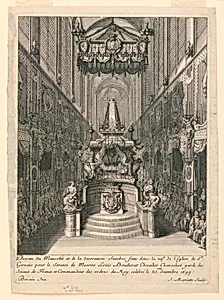
Catafalque of Louis Boucherat, Second State, St. Gervais, Paris
Classification
Department
Smithsonian Collection
Museum
Smithsonian American Art Museum
Credit
Museum purchase through gift of Mrs. William G. Fitch
Accession Number
1962-192-9
Rights
Public Domain
About this artwork
Research in Progress
Art Historical Context
**Catafalque of Louis Boucherat, Second State, St. Gervais, Paris** *Jean Berain the elder (French, 1640–1711), 1699* *Print; Smithsonian American Art Museum, Museum purchase through gift of. William G. FitchJean Berain the elder, a master designer and engraver at the court of Louis XIV, created this evocative print depicting the grand catafalque—a temporary, ornate funerary structure—for Louis Boucherat, the Chancellor of France who died in 1699. Rendered as the "second state," this likely refers to a refined edition of the print, capturing the elaborate funeral monument erected at the Church of St. Gervais in Paris. Berain's work exemplifies the opulent Baroque style of late 17th-century France, where such designs blended architecture, sculpture, and symbolism to honor the elite amid the Sun King's absolutist splendor. As a print, the medium allowed widespread dissemination of these ceremonial designs, serving both as a commemorative record and an inspirational template for Europe's nobility. Berain, renowned for his intricate ornamental motifs that influenced Rococo aesthetics, infused the catafalque with dramatic flourishes—draperies, columns, and allegorical figures evoking mourning and glory. This piece reflects the era's fusion of art and ritual, underscoring how visual culture amplified royal power and personal legacy. Though research continues, the print offers a window into Versailles-era pageantry, inviting us to ponder the theatricality of death in the grandeur of ancien régime France. (198 words)