
Cats
1868–69
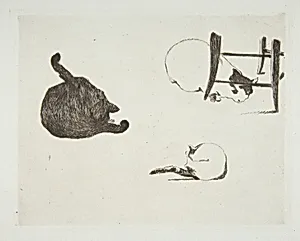
Medium
Etching on blue laid paper, only state
Dimensions
plate: 6 5/8 x 8 7/16in. (16.8 x 21.4cm) sheet: 9 1/2 x 13 3/8in. (24.1 x 34cm)
Classification
Prints
Department
Drawings and Prints
Museum
Metropolitan Museum of Art, New York, NY
Credit
Rogers Fund, 1921
Accession Number
21.76.26
Rights
Public Domain
Tags
Art Historical Context
Edouard Manet's *Cats* (1868–69) is a charming etching that captures the artist's playful side amid his groundbreaking work in painting. Created during a pivotal period when Manet was challenging academic conventions and paving the way for Impressionism this intimate print depicts feline with loose, expressive lines typical of his realist yet innovative style. The work's small scale—plate size just 6⅝ × 8⅞ inches—invites close viewing, evoking the curiosity of domestic cats themselves. Rendered in a single state on rare blue laid paper, the etching showcases Manet's mastery of intaglio printmaking. He incised the design directly into a metal plate, allowing acid to etch fine details before inking and printing. This "only state" means no revisions were made, preserving the spontaneity of his hand. Etchings like this were innovative for their time, bridging fine art and reproduction to reach broader audiences beyond oil paintings like *Olympia*. Acquired by The Metropolitan Museum of Art in 1921 through the Rogers Fund, *Cats* highlights Manet's versatility and affection for everyday motifs. Cats in 19th-century French art often symbolized independence and mystery, making this a delightful glimpse into the artist's lighter, more personal explorations. A purr-fect gem for print enthusiasts!
About the Artist
Edouard Manet · 1832–1883
Édouard Manet (1832-1883) was a French painter who played a pivotal role in the transition from Realism to Impressionism, often called the 'Father of Modern Art.' Born into a wealthy Parisian family, Manet defied his father's wishes for a legal career to pursue painting, studying under academic artist Thomas Couture. His revolutionary works 'Le Déjeuner sur l'herbe' and 'Olympia' (both 1863) scand...