
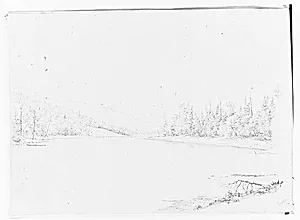
Catskill, 1864 (from Sketchbook)
Medium
Graphite on buff paper
Dimensions
9 3/4 x 13 7/8 in. (24.8 x 35.2 cm)
Classification
Drawing
Culture
American
Department
The American Wing
Museum
Metropolitan Museum of Art, New York, NY
Credit
Purchase, Sheila and Richard J. Schwartz Fund and Gifts in memory of Stephen D. Rubin, 1992
Accession Number
1992.373.11 verso
Rights
Public Domain
Tags
Art Historical Context
Thomas Hewes Hinckley's *Catskill, 1864 (from Sketchbook)* captures the majestic Catskill Mountains of New York in a delicate graphite sketch on buff paper. Created during the height of the American Civil War this intimate landscape drawing reflects the era's fascination with the American wilderness as a source of national pride and solace. Measuring 9 3/4 x 13 7/8 inches, it showcases Hinckley's keen eye for natural forms, particularly the textured trees that dominate the composition, evoking the beauty of the Hudson River region. As a preparatory sketch from Hinckley's sketchbook, the work highlights the artist's reliance on graphite—a versatile medium favored by 19th-century American draftsmen for its precision and portability. The buff paper adds a warm undertone, enhancing the subtle shading and atmospheric depth that bring the Catskills to life. This technique underscores the Romantic tradition in American art, where quick studies like this often served as foundations for larger paintings celebrating nature's grandeur. Housed in The Metropolitan Museum of Art's American Wing, *Catskill* exemplifies everyday artistic practice amid historical tumult. Acquired in 1992 through public and memorial gifts, it invites visitors to appreciate how such modest sketches preserve the spirit of 1860s America, bridging personal observation with cultural reverence for the land.
About the Artist
Thomas Hewes Hinckley · 1813–1896
Thomas Hewes Hinckley (1813–1896) was an American painter who became one of the leading specialists in animal painting in the United States during the mid-nineteenth century. Born in Milton, Massachusetts, he was largely self-taught in his early years, developing his skills through sustained observation of animals in the field and study of European masters whose work he encountered in reproduction...