
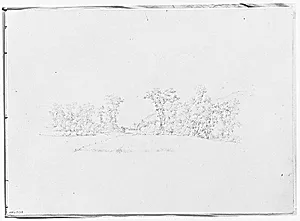
Farm Meadow Bordered by Trees (from Sketchbook)
ca. 1860–ca. 1864
Medium
Graphite on beige paper
Dimensions
9 3/4 x 13 7/8 in. (24.8 x 35.2 cm)
Classification
Drawing
Culture
American
Department
The American Wing
Museum
Metropolitan Museum of Art, New York, NY
Credit
Purchase, Sheila and Richard J. Schwartz Fund and Gifts in memory of Stephen D. Rubin, 1992
Accession Number
1992.373.9
Rights
Public Domain
Tags
Art Historical Context
This delicate graphite sketch by Thomas Hewes Hinckley captures a tranquil American farm meadow framed by a gentle line of trees. Created between 1860 and 1864 on beige paper, the drawing measures roughly 10 by 14 inches and offers an intimate glimpse into rural life during a pivotal era in United States history. As a page from the artist’s sketchbook, it likely served as a quick study made outdoors, recording the quiet rhythms of the countryside with economical lines and subtle shading. Hinckley, an American artist associated with the 19th-century interest in natural scenery, used graphite’s soft tonal range to suggest light filtering through foliage and the open expanse of meadow. Such sketches reveal the artist’s working method—gathering direct impressions that could later inform larger studio paintings. Today, the work resides in the Metropolitan Museum’s American Wing, where it speaks to the period’s fascination with the land as both a source of livelihood and a subject worthy of careful observation.
About the Artist
Thomas Hewes Hinckley · 1813–1896
Thomas Hewes Hinckley (1813–1896) was an American painter who became one of the leading specialists in animal painting in the United States during the mid-nineteenth century. Born in Milton, Massachusetts, he was largely self-taught in his early years, developing his skills through sustained observation of animals in the field and study of European masters whose work he encountered in reproduction...