
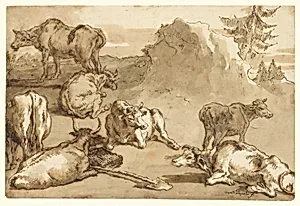
Cattle in a Landscape
mid-18th–early 19th century
Medium
Pen and brown ink, brown wash, over black chalk
Dimensions
7 3/8 x 11 in. (18.7 x 28 cm)
Classification
Drawings
Department
Robert Lehman Collection
Museum
Metropolitan Museum of Art, New York, NY
Credit
Robert Lehman Collection, 1975
Accession Number
1975.1.529
Rights
Public Domain
Tags
Art Historical Context
Giovanni Domenico Tiepolo, gifted son of the renowned Venetian master Giambattista Tolo, created *Cattle in a Landscape during the mid-18 to early 19th. This intimate drawing captures a serene pastoral, with cows grazing amid a expansive, softly lit landscape—a motif echoing the Venetian tradition of idyllic rural life. Rendered on a modest sheet measuring 7 3/8 x 11 inches, it exemplifies Tiepolo's prowess in sketch-like studies, blending observation from nature with imaginative flourish characteristic of the late Rococo style. Executed in pen and brown ink with brown wash over black chalk, the work showcases virtuoso techniques of the period. The black chalk underdrawing provides a loose structural foundation, while the fluid ink lines and translucent wash build depth and atmosphere, evoking the golden light of the Veneto countryside. Such mixed-media drawings were often preparatory for larger frescoes or paintings but stood alone as finished artworks, prized for their spontaneity and vitality. Housed in the Robert Lehman Collection at The Metropolitan Museum of Art since 1975, this piece highlights Tiepolo's enduring influence in European draftsmanship. It invites visitors to appreciate the quiet poetry of everyday pastoral subjects, a counterpoint to the grandeur of his father's mythological frescoes, revealing the artist's sensitive eye for nature's rhythms.
About the Artist
Giovanni Domenico Tiepolo · 1727–1804
Giovanni Domenico Tiepolo (1727-1804) was a Venetian painter, printmaker, and draftsman whose career spanned the twilight of the Rococo era. Born on August 30, 1727, in Venice as the eldest son of the celebrated Giovanni Battista Tiepolo, he worked both in his father's shadow and as a significant independent artist who developed a distinctly earthbound and humanistic vision. Domenico's importance...