
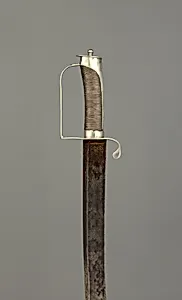
Cavalry Officer's Saber
ca. 1810
Medium
Steel, silver, wood, gold
Dimensions
H. 39 7/8 in. (101.3 cm); H. of blade 34 1/4 in. (87 cm); W. 3 3/4 in. (9.5 cm); Wt. 1 lb. 9.6 oz. (725.7 g)
Classification
Swords
Culture
American, Baltimore
Department
Arms and Armor
Museum
Metropolitan Museum of Art, New York, NY
Credit
Purchase, Arthur Ochs Sulzberger Bequest, 2015
Accession Number
2015.127
Rights
Public Domain
Art Historical Context
This elegant Cavalry Officer's Saber, crafted by Baltimore silversmith John Lynch 1810, exemplifies finest American arms-making of the early Republic. Measuring nearly 40 inches overall with a 34-inch steel blade, it was designed for mounted cavalry use, balancing lethal functionality with officer-class refinement. Lynch, a prominent figure in Baltimore's thriving silver trade, adorned the hilt with silver mounts, gold accents, and a wooden grip, showcasing the city's reputation as a center for high-quality metalwork during a time of national pride and military expansion. The saber's opulent materials—steel for the razor-sharp blade, silver and gold for decorative flourishes—highlight the fusion of utility and artistry in early 19th-century America. Such weapons were not just tools of war but symbols of status, often carried into conflicts like the War of 1812. Baltimore artisans like Lynch drew on European influences while developing a distinctly American style, emphasizing bold proportions and intricate chasing techniques that elevated functional arms to sculptural beauty. Today, this saber in the Metropolitan Museum of Art's Arms and Armor collection offers a tangible link to America's formative years, reminding us how craftsmanship reflected the era's martial spirit and growing industrial prowess.