
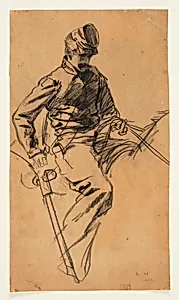
Cavalry Soldier
Classification
figures
Department
Smithsonian Collection
Museum
Smithsonian American Art Museum
Credit
Gift of Charles Savage Homer, Jr.
Accession Number
1912-12-106
Rights
Public Domain
About this artwork
Research in Progress
Art Historical Context
Winslow Homer, one of America's foremost realist painters (1836–1910), created *Cavalry Soldier in 1863, at the height of the Civil War. As a young artist and illustrator for *Harper's Weekly*, Homer embedded with Union troops, sketching soldiers amid the conflict's harsh realities. This work, classified as a figure study, likely captures the stoic vigilance of a cavalryman—a key figure in the war's mobile warfare—reflecting Homer's firsthand observations of military life. Homer's style bridged journalism and fine art, emphasizing raw honesty over romanticism. His depictions of soldiers humanized the war, portraying individuals rather than glorified heroes, which influenced later American realism. Though the medium remains unidentified amid ongoing research, the piece exemplifies Homer's skill in conveying character through posture and expression. Today, *Cavalry Soldier* graces the Smithsonian American Art Museum, a gift from Charles Savage Homer, Jr., the artist's brother. It offers visitors a poignant window into 19th-century America, reminding us of the personal toll of national division.