
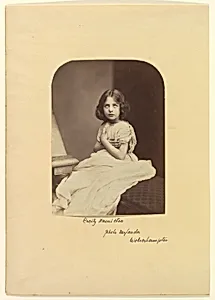
Cecily Hamilton
1863–1867
Medium
Albumen silver print from glass negative
Dimensions
Image: 7 3/16 × 5 1/4 in. (18.3 × 13.3 cm), rounded top Mount: 13 7/16 in. × 9 7/16 in. (34.1 × 24 cm)
Classification
Photographs
Department
Photographs
Museum
Metropolitan Museum of Art, New York, NY
Credit
David Hunter McAlpin Fund, 1946
Accession Number
46.1.45
Rights
Public Domain
Tags
Art Historical Context
**Cecily Hamilton** (1863–1867) is a delicate portrait by Oscar Gustav Rejlander, a pioneering-born photographer active in Victorian England. Captured as an albumen print from a glass negative this intimate image measures just 7 3/16 × 5 1/4 inches and features a softly rounded top, evoking the carte-de-visite format popular for personal keepsakes. Now housed in The Metropolitan Museum of Art's Photographs Department (David Hunter McAlpin Fund 1946), it showcases Rejlander's mastery in rendering subtle expressions and textures through early wet-collodion negatives. Rejlander, often called the "father of art photography," blurred the lines between painting and photography with his innovative combination printing techniques, though this straightforward portrait highlights his skill in natural lighting and emotional depth. Albumen prints, coated with egg whites for a glossy sheen and warm tones, were the gold standard of the 1860s, allowing rich detail in fabrics and skin that brought photographic portraits to life amid the era's booming middle-class fascination with family imagery. This tender depiction of a young girl named Cecily reflects Victorian ideals of childhood innocence, where such photographs served as cherished mementos. Its cultural resonance lies in preserving fleeting youth through a medium revolutionizing visual storytelling, inviting viewers to ponder the gaze of a bygone innocence. (198 words)