
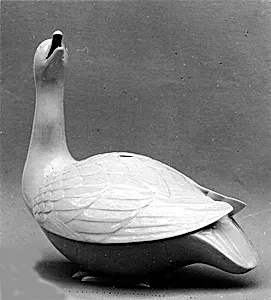
Censer In Form of a Goose
Unknown Artist
1830
Medium
Pure white porcelain (Hirado ware)
Dimensions
H. 9 1/2 in. (24.1 cm); L. 11 1/4 in. (28.6 cm)
Classification
Ceramics
Culture & Period
Japan · Edo period (1615–1868)
Department
Asian Art
Museum
Metropolitan Museum of Art, New York, NY
Credit
Gift of Mrs. V. Everit Macy, 1923
Accession Number
23.225.106
Rights
Public Domain
Tags
Art Historical Context
Behold the *Censer in Form of a Goose*, a delightful example of Edo-period Japanese porcelain craftsmanship from 1830. Crafted in pure white Hirado ware—a renowned specialty from the kilns of Hirado Island—this incense burner takes the naturalistic shape of a serene goose, measuring 9½ inches high and 11¼ long. Its smooth, unglazed surface exemplifies the material's exceptional purity and translucency, achieved through meticulous molding and firing techniques that highlight the potter's skill in capturing lifelike feathers and poised posture. Produced during Japan's Edo period (1615–1868), a time of relative peace and flourishing arts, Hirado ware pieces like this were prized for both utilitarian and decorative purposes. Censers, used to burn incense in tea ceremonies, Buddhist rituals, or home altars, often featured whimsical animal forms symbolizing harmony with nature. The goose, evoking grace and migration, adds a poetic touch, blending functionality with artistry in the ukiyo-e spirit of everyday beauty. Now housed in the Metropolitan Museum of Art's Asian Art Department (gift of Mrs. V. Everit Macy, 1923), this unknown artist's creation invites visitors to appreciate the subtlety of Japanese ceramics—where form, function, and cultural reverence converge in elegant simplicity.