
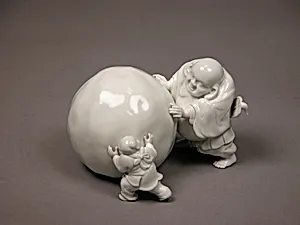
白磁布袋唐子雪玉形置物|Snowball Pushed by Hotei and a Child
Unknown Artist
mid-19th century
Medium
White porcelain (Hirado ware)
Dimensions
H. 3 5/8 in. (9.2 cm); W. 5 3/8 in. (13.7 cm)
Classification
Ceramics
Culture & Period
Japan · Edo period (1615–1868)
Department
Asian Art
Museum
Metropolitan Museum of Art, New York, NY
Credit
Gift of Mrs. V. Everit Macy, 1923
Accession Number
23.225.52
Rights
Public Domain
Tags
Art Historical Context
This charming porcelain figurine, titled *Snowball Pushed by Hotei and a Child*, captures a joyful moment from mid-19th-century Japan during the Edo period (1615–1868). Crafted in fine white Hirado ware—a prestigious porcelain from the kilns of Hirado Island, Nagasaki—the piece stands just 3⅝ inches tall and 5⅜ inches wide. Its pristine, ivory-toned surface evokes the elegance of Chinese blanc de chine, prized for its translucency and purity, making it ideal for delicate sculptural forms. The scene features Hotei, one of Japan's beloved Seven Lucky Gods (Shichifukujin), symbolizing fortune, happiness, and abundance. Often depicted as a jolly, pot-bellied figure with a sack of treasures, here he playfully pushes a massive snowball alongside a child, blending folklore with winter whimsy. Such *okimono* (shelf ornaments) were popular in urban households, reflecting Edo Japan's vibrant culture of everyday prosperity and familial delight amid the era's peace and artistic refinement. Hirado artisans' mastery shines in the subtle modeling of dynamic poses and smooth, unadorned surfaces, achieved through precise molding and high-fired kaolin clay. Donated to the Metropolitan Museum of Art in 1923, this anonymous work highlights Japan's ceramic innovation, inviting viewers to smile at its timeless, heartwarming narrative.