
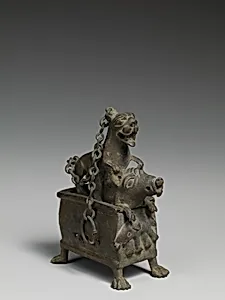
Censer with a Lioness Hunting a Boar
Unknown Artist
6th–7th century
Medium
Bronze
Dimensions
Overall: 5 3/16 x 4 1/8 x 2 1/16 in. (13.2 x 10.4 x 5.3 cm) Overall (with chain suspended): 8 13/16 x 4 1/8 x 2 1/16 in. (22.4 x 10.4 x 5.3 cm)
Classification
Metalwork-Bronze
Culture
Coptic
Department
Medieval Art
Museum
Metropolitan Museum of Art, New York, NY
Credit
Rogers Fund, 1944
Accession Number
44.20a, b
Rights
Public Domain
Tags
Art Historical Context
This bronze censer, created in the 6th or 7th century by an unknown Coptic artist, exemplifies the rich metalworking traditions of early Christian Egypt. Coptic culture, centered in Egypt during the late antique and early medieval periods, blended indigenous Egyptian motifs with Christian symbolism. The vessel’s compact form, designed to hold burning incense, features a lively scene of a lioness pursuing a boar, rendered in relief on the bronze surface. Such animal imagery likely carried protective or allegorical meaning, evoking strength and the triumph of good over adversity. Measuring just over five inches when resting, the censer could be suspended by its chain for use in liturgical settings. The choice of durable bronze allowed artisans to create both functional objects and portable works of art that traveled along trade routes and through religious communities. Today housed in the Metropolitan Museum of Art’s Medieval Art collection, this piece offers visitors a tangible connection to the daily devotional practices of Coptic Christians more than 1,400 years ago.