
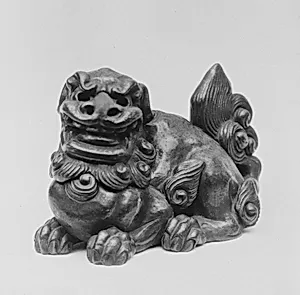
Censer with cover
Unknown Artist
1750
Medium
Stoneware covered with flecked glaze (Bizen ware)
Dimensions
H. 4 in. (10.2 cm); W. 6 1/2 in. (16.5 cm); D. 3 1/2 in. (8.9 cm)
Classification
Ceramics
Culture & Period
Japan · Edo period (1615–1868)
Department
Asian Art
Museum
Metropolitan Museum of Art, New York, NY
Credit
Gift of Mrs. V. Everit Macy, 1923
Accession Number
23.225.39a, b
Rights
Public Domain
Tags
Art Historical Context
This charming censer with cover, crafted in 1750 during Japan's Edo period (16151868), exemplifies the elegance of Bizen ware, a renowned stoneware tradition from Okayama Prefecture. Standing just 4 inches tall and measuring 6½ inches wide, this compact ceramic vessel features a flecked glaze achieved through high-temperature wood-firing, where natural ash creates unique speckled patterns and subtle color variations. Produced by an unknown artisan, it likely bears animal motifs, reflecting the period's fondness for nature-inspired designs in everyday ritual objects. Censers like this were essential for burning incense in tea ceremonies, Buddhist rituals, and home altars, embodying the Edo era's refined domestic culture amid prolonged peace and prosperity. Bizen ware's durability and earthy aesthetic—often unglazed or minimally coated—prized simplicity and harmony with nature, techniques passed down for centuries without painted decoration. Its presence in the Metropolitan Museum of Art's Asian Art collection, gifted by Mrs. V. Everit Macy in 1923, highlights the global appreciation for Japanese ceramics. Intriguing for collectors, this piece captures Bizen's "living" quality, where each firing yields one-of-a-kind results, inviting visitors to ponder the hands that shaped it over 270 years ago.