
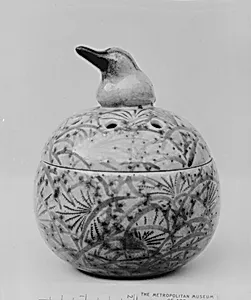
Censer with Kingfisher Knob
1820
Medium
Faience with enamels (Kyoto ware)
Dimensions
H. 5 1/8 in. (13 cm); Diam. 4 1/4 in. (10.8 cm)
Classification
Ceramics
Culture & Period
Japan · Edo period (1615–1868)
Department
Asian Art
Museum
Metropolitan Museum of Art, New York, NY
Credit
Gift of Mrs. V. Everit Macy, 1923
Accession Number
23.225.275a, b
Rights
Public Domain
Tags
Art Historical Context
This elegant censer, crafted in 1820 by the Japanese potter Eiraku Hozen, exemplifies the refined ceramic traditions of Kyoto ware during the Edo period. Standing just over five inches tall, the vessel features a charming kingfisher perched as its knob, a detail that highlights the era’s appreciation for naturalistic motifs drawn from the natural world. Made of faience with vibrant enamels, the piece reflects the technical mastery of Kyoto potters who combined functionality with delicate ornamentation. As an incense burner, the censer would have played a role in both domestic rituals and the refined tea ceremony, where the gentle release of fragrance enhanced moments of contemplation. Hozen’s work captures the Edo period’s blend of artistic innovation and cultural continuity, transforming a utilitarian object into a small-scale sculpture. Now part of the Metropolitan Museum of Art’s Asian Art collection, this Kyoto ware censer invites viewers to appreciate the quiet beauty of Japanese ceramics from nearly two centuries ago.
About the Artist
Eiraku Hozen · 1795–1854
Eiraku Hozen (1795–1854) was a celebrated Japanese ceramic artist and the sixteenth-generation head of the Nishimura family, a Kyoto dynasty of potters whose work was closely associated with the tastes of the imperial court and the refined aesthetic culture of the ancient capital. Operating under the artistic name Eiraku — a name that would become synonymous with a particular style of elegant, tec...