
Centaur
Unknown Artist
17th century
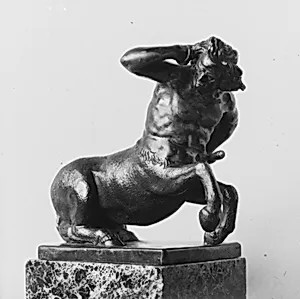
Medium
Bronze, colored marble base
Dimensions
Overall: 5 × 5 3/8 in. (12.7 × 13.7 cm)
Classification
Sculpture-Bronze
Culture
Italian
Department
European Sculpture and Decorative Arts
Museum
Metropolitan Museum of Art, New York, NY
Credit
Gift of Ogden Mills, 1925
Accession Number
25.142.20
Rights
Public Domain
Tags
Art Historical Context
This exquisite bronze *Centaur*, crafted by an unknown Italian artist in the 17th century captures the mythical half-human, half-horse figure from ancient Greek lore, reimagined in the vibrant artistic traditions of Baroque Italy. Standing just 5 × 5 3/8 inches (12.7 × 13.7 cm) tall on its colorful marble base, this small-scale sculpture was likely designed as a luxurious tabletop ornament for a collector's cabinet of curiosities, blending classical mythology with Renaissance revivalism. Bronze casting, a demanding lost-wax technique perfected in Italy since antiquity, allowed for intricate details in the centaur's muscular form and dynamic pose, evoking movement and raw power. During the 17th century, such figurines proliferated in workshops across Florence and Venice, serving as both decorative confections and symbols of erudition—centaurs representing untamed nature tamed by human intellect. A generous gift from Ogden Mills in 1925, this piece now graces the Metropolitan Museum of Art's European Sculpture and Decorative Arts collection, inviting visitors to ponder how 17th-century Italians bridged pagan myths with Christian-era opulence. Its compact elegance reminds us of art's power to make legends intimately tangible.