
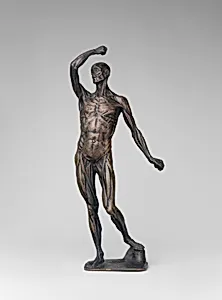
Ecorché
after 1761
Medium
Bronze, marble base
Dimensions
Height: 9 3/4 in. (24.8 cm)
Classification
Sculpture-Bronze
Culture
British
Department
European Sculpture and Decorative Arts
Museum
Metropolitan Museum of Art, New York, NY
Credit
Gift of Ogden Mills, 1925
Accession Number
25.142.11
Rights
Public Domain
Tags
Art Historical Context
Behold the *Ecorché* by Michael Henry Spang, striking bronze sculpture crafted after 1761 and standing just 9¾ inches tall on its marble base. This British work, classified as a male nude, exemplifies the 18th-century fascination with human anatomy, depicting a flayed figure whose exposed musculature reveals the intricate workings beneath the skin. Spang, a sculptor active in London’s artistic circles, captured the male form in dynamic tension, poised as if in motion, making it a masterful study in proportion and realism. Historically, écorché figures like this one were essential tools in European art academies, aiding artists in mastering the classical ideals of the body popularized during the Renaissance and revived in the Neoclassical era. Cast in bronze—a durable medium prized for its ability to hold fine details—Spang’s piece reflects the technical prowess of British foundries at the time, blending scientific precision with aesthetic grace. Its small scale suggests it was likely intended for a studio or private collection, serving as both educational model and decorative object. Today, this gem resides in the Metropolitan Museum of Art’s Department of European Sculpture and Decorative Arts, a gift from Ogden Mills in 1925. Visitors are drawn to its raw intensity, a testament to how 18th-century artists bridged art and anatomy to honor the human form’s enduring beauty.