
Centaur Woman
1826 to 1850
Medium
pen and brown ink over graphite on wove paper
Dimensions
overall (approximate): 29.5 x 42.1 cm (11 5/8 x 16 9/16 in.)
Classification
Drawing
Department
CG-E
Museum
National Gallery of Art, Washington, D.C.
Credit
Rosenwald Collection
Accession Number
1943.3.5509
Rights
Public Domain
Art Historical Context
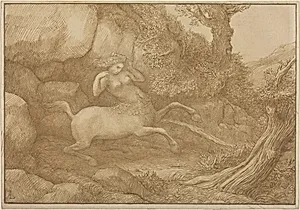
Alphonse Legros created *Centaur Woman* as a striking exploration of mythological themes rendered in pen and brown ink over graphite on wove paper. The drawing, measuring approximately 29.5 by 42.1 centimeters, depicts the hybrid figure with careful attention to form and movement, blending human and equine elements in a dynamic composition. Legros, a French artist active in the mid-nineteenth century, often drew from classical subjects while working within the Realist tradition, using such imagery to examine the boundaries between the natural and the fantastical. The medium itself highlights the artist’s technical skill, with fluid ink lines building upon delicate graphite underdrawing to create depth and texture. This approach was common in preparatory or standalone works on paper during the period, allowing for expressive freedom that prints or paintings might not permit. Housed in the National Gallery of Art’s Rosenwald Collection, the piece reflects the era’s renewed interest in ancient myths as vehicles for artistic innovation. Visitors can appreciate how Legros transforms a legendary creature into a study of anatomy and imagination, inviting contemplation of human identity through this hybrid form. The drawing’s intimate scale encourages close viewing, revealing the subtle interplay of line and tone that brings the centaur to life.
About the Artist
Alphonse Legros · 1837–1911
Alphonse Legros (1837–1911) was born in Dijon, France, and trained in Paris at the drawing school of Horace Lecoq de Boisbaudran, whose unconventional teaching method — which emphasised memory drawing and acute observation over academic convention — would leave a lasting mark on Legros's practice. At Lecoq's school he formed friendships with Jules Dalou and Auguste Rodin that endured throughout hi...