
Centerpiece
19th century
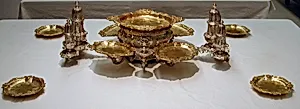
Medium
Silver on base metal
Dimensions
Overall: 10 × 18 × 31 in. (25.4 × 45.7 × 78.7 cm)
Classification
Metalwork-Electrotype
Culture
British, after British, London original
Department
European Sculpture and Decorative Arts
Museum
Metropolitan Museum of Art, New York, NY
Credit
Gift of Henry G. Marquand, 1883
Accession Number
83.18.24a–rr
Rights
Public Domain
Art Historical Context
This elegant *Centerpiece* is a19th-century electrotype of an original London silver creation by Paul de Lamer, the renowned British Huguenot silversmith1688–1751). De Lamerie was a master of the Rococo style, crafting ornate tableware for the elite with intricate chasing, embossing, and mythological motifs that epitomized 18th-century luxury. Standing at an impressive 10 × 18 × 31 inches, this centerpiece would have graced grand dining tables, symbolizing wealth and refined taste. The medium—silver electroplated on base metal—highlights a pivotal 19th-century innovation: electrotyping, pioneered in the 1840s, allowed museums and collectors to replicate precious originals affordably and precisely using electrolysis. This technique preserved de Lamerie's artistry for wider appreciation without risking the fragile antique. Gifted to the Metropolitan Museum of Art in 1883 by Henry G. Marquand, it reflects the era's passion for historicism and the growing accessibility of decorative arts. As part of the European Sculpture and Decorative Arts collection, this piece invites visitors to explore British metalwork's evolution, from opulent Georgian silver to Victorian ingenuity.
About the Artist
Paul de Lamerie · 1688–1751
Paul de Lamerie was born on April 9, 1688, in 's-Hertogenbosch in the Dutch Republic, the son of Paul Souchay de la Merie, a French Huguenot nobleman who had fled France following the revocation of the Edict of Nantes in 1685 and subsequently served as an officer under William III of Orange. The family settled in London by 1691, and young Paul grew up in a community of skilled Huguenot craftsmen w...