
Ceramic Fragment
Unknown Artist
14th–15th century
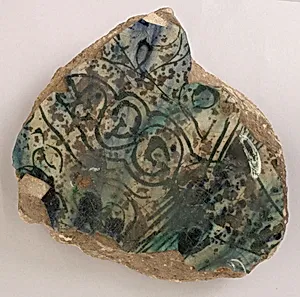
Medium
Stonepaste; polychrome underglaze painted under colorless glaze
Classification
Ceramics
Department
Islamic Art
Museum
Metropolitan Museum of Art, New York, NY
Credit
Rogers Fund, 1913
Accession Number
13.190.25
Rights
Public Domain
Art Historical Context
This delicate Ceramic Fragment, dating to the 14th–15th century, hails from the rich tradition of Islamic ceramics and exemplifies the ingenuity of artisans in the medieval Islamic world. Crafted stonepaste—a fine, vitreous composite of quartz, clay, and glass frit that mimicked the prized Chinese porcelain—this shard was adorned with polychrome undergl painting beneath a colorless glaze. This allowed for vibrant, durable colors that withstood daily use, whether on vessels, tiles, architectural elements. The underglaze technique, perfected in regions like Syria, Egypt, and Persia during this era, marked a pinnacle of Islamic ceramic innovation. Colors such as cobalt blue, turquoise, and manganese purple were applied directly to the unfired body before glazing and a single high-temperature firing, ensuring motifs remained sharp and unfading. Though only a fragment survives, it whispers of the era's opulent designs—likely floral arabesques, geometric patterns, or calligraphy—reflecting cultural values of beauty, symmetry, and spirituality. Acquired through the Rogers Fund in 1913, this piece at the Metropolitan Museum of Art invites us to ponder the anonymous master's skill and the vibrant trade networks that spread such artistry across the Islamic realm. A testament to enduring craftsmanship!