
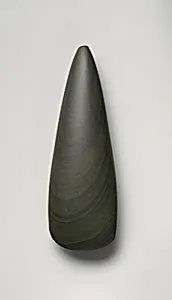
Ceremonial Axe
Unknown Artist
7th–15th century
Medium
Greenstone
Dimensions
H. 5 3/8 × W. 1 7/8 × D. 1/2 in. (13.7 × 4.8 × 1.3 cm)
Classification
Stone-Implements
Culture
Taíno
Department
Arts of Africa, Oceania, and the Americas
Museum
Metropolitan Museum of Art, New York, NY
Credit
Gift of Vincent and Margaret Fay, 1982
Accession Number
1982.77.2
Rights
Public Domain
Art Historical Context
This exquisite Ceremonial Axe, by an unknown Taíno artist the 7th and 15th centuries, hails from the indigenous Taíno culture of the Caribbean, particularly the Greater Antilles like Cuba, Jamaica, and Hispaniola Carved from polished greenstone—a durable, vibrant stone prized for its deep color symbolizing life and fertility—the axe exemplifies pre-Columbian mastery in stoneworking. Measuring just 5⅜ inches tall, its compact form belies its ritual power, as Taíno artisans shaped it through meticulous pecking, grinding, and polishing techniques, achieving a smooth, gleaming surface without metal tools. Far from a mere utilitarian implement, this axe likely served ceremonial purposes in Taíno society, where such objects embodied spiritual authority. Chiefs (caciques) wielded them as symbols of power during rituals, possibly invoking deities like Yúcahu, the god of cassava and fertility. Greenstone celts like this one were often hafted onto wooden handles for use in dances or offerings, bridging the earthly and supernatural worlds. Its presence in the Metropolitan Museum of Art, a gift from Vincent and Margaret Fay in 1982, offers a tangible link to a vibrant culture devastated by European contact after 1492. Admire the axe’s elegant symmetry and tactile allure— a testament to Taíno ingenuity that continues to captivate.