
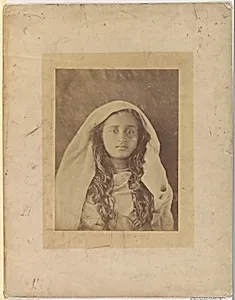
Ceylonese Woman
1875–79
Medium
Albumen silver print from glass negative
Classification
Photographs
Department
Photographs
Museum
Metropolitan Museum of Art, New York, NY
Credit
The Elisha Whittelsey Collection, The Elisha Whittelsey Fund, 1969
Accession Number
69.607.3
Rights
Public Domain
Tags
Art Historical Context
Julia Margaret Cameron created *Ceylonese Woman* during the final years of her career, after she and her husband relocated to Ceylon (present-day Sri Lanka) in 1875. The albumen silver print captures a local woman in a close, intimate view typical of Cameron’s portraiture. This medium, which uses egg-white emulsion on paper to produce rich tonal depth and fine detail, was the dominant photographic process of the Victorian era and helped elevate photography to an artistic medium. Cameron’s approach favored soft focus and dramatic lighting, giving her subjects an almost timeless, sculptural quality. Here, the sitter’s direct gaze and traditional attire reflect both personal encounter and the broader cultural exchanges of the British colonial period. As part of the Metropolitan Museum’s photography collection, the work illustrates Cameron’s continued experimentation with the camera far from the literary and artistic circles of London. Today the print stands as a poignant record of cross-cultural portraiture at a moment when photography was redefining how people saw one another across continents.
About the Artist
Julia Margaret Cameron · 1815–1879
Julia Margaret Cameron (1815–1879), born Julia Margaret Pattle in Calcutta, India, emerged as one of the 19th century's most innovative photographers despite beginning her career at age 48. The daughter of East India Company official James Pattle and French aristocrat Adeline de l'Etang, she was educated in France from 1818 to 1834 alongside her six surviving sisters, renowned for their beauty and...