
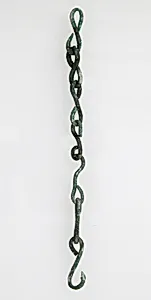
Chain
Unknown Artist
6th–7th century
Medium
Copper alloy
Dimensions
Overall: 5 1/8 x 3/16 x 3/16 in. (13 x 0.5 x 0.5 cm)
Classification
Metalwork-Copper alloy
Culture
Frankish
Department
Medieval Art
Museum
Metropolitan Museum of Art, New York, NY
Credit
Gift of J. Pierpont Morgan, 1917
Accession Number
17.193.38b
Rights
Public Domain
Art Historical Context
This delicate copper alloy chain, crafted by an unknown Frankish artisan in the 6th–7th century exemplifies the refined metalworking skills of the Merovingian. Measuring just over 5 inches long and remarkably slender at a mere 3/16 inch in width and thickness, it was likely used as jewelry—perhaps a necklace or bracelet component—highlighting the Franks' expertise in manipulating non-precious metals for everyday adornment and status display. The chain's survival speaks to the durability of copper alloys, which were cast, drawn, and linked using techniques inherited from late Roman traditions but adapted for a post-Roman world. In the turbulent era of the Frankish kingdoms, which dominated much of western Europe after the fall of Rome, such metalwork reflected cultural transitions and emerging Christian influences. Frankish artisans produced intricate objects for personal wear, horse fittings, and reliquaries, blending utilitarian function with subtle ornamentation. This piece, now in the Metropolitan Museum of Art's Medieval Art collection thanks to a 1917 gift from J. Pierpont Morgan, offers a tangible glimpse into daily life among the early medieval elite, where even small items conveyed wealth and craftsmanship. Though simple in form, the chain's precision underscores the period's technological prowess, reminding us how Frankish innovations laid groundwork for later medieval jewelry traditions.