
Chalice
c. 1500–c. 1520
Medium
Silver gilt and enamel
Dimensions
H.: 24.5 cm (9 11/16 in.)
Classification
chalices (liturginal vessels)
Department
Applied Arts of Europe
Museum
Art Institute of Chicago
Accession Number
230956
Rights
Public Domain
About this artwork
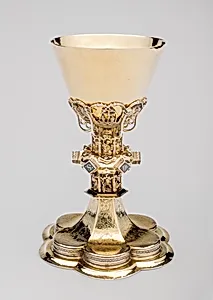
This chalice stands on a foot with six lobes, each with an engraving of a saint. On the stem are additional images of the Crucifixion, the four fathers of the Church (Saints Ambrose, Augustine, Jerome and Gregory), and Saint Agnes, each modeled of gilt silver and ensconced in Gothic arches. Above these miniature sculptural components are enameled plaques spelling out IHESUS (Jesus). As the imagery suggests, this chalice was used for Christian liturgical ceremony of the Eucharist to hold wine as...
Art Historical Context
This exquisite chalice, crafted around 1500–1520, exemplifies the pinnacle of European applied arts during the late Gothic to early Renaissance transition. Standing at 24.5 cm tall, it served as a liturgical vessel in Christian worship, holding wine for the Eucharist during Mass. Its anonymous maker reflects the collaborative workshops of the era, where skilled metalworkers produced sacred objects for churches and cathedrals across Europe, blending functionality with profound spiritual symbolism. The chalice's medium—silver gilt and enamelhighlights masterful techniques that elevated metalwork to high art. Silver gilt, created by fire-gilding (mercury-gold amalgam heated onto silver), lent a radiant golden sheen evoking divine light. Translucent and painted enamels, fired onto the surface in vibrant colors, added intricate motifs like floral patterns or religious scenes, showcasing the era's virtuosity in vitreous enameling—a labor-intensive process requiring multiple kiln firings for depth and luminosity. Housed in the Art Institute of Chicago's Department of Applied Arts of Europe, this chalice underscores the cultural importance of liturgical metalwork, which commissioned the finest craftsmanship to honor faith. Though its exact origin remains mysterious, it invites visitors to ponder the devotion and artistry poured into everyday sacred rituals.
About the Artist
Unknown
The artist designated as "Unknown" in our virtual museum's collection exemplifies a poignant chapter in art history: creators whose identities have faded into obscurity despite the enduring power of their work. With only one known artwork attributed to them in our holdings, this figure represents countless anonymous hands that shaped visual culture across centuries. Museums worldwide, including th...