
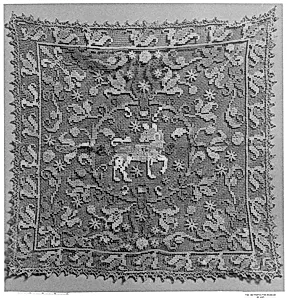
Chalice veil
Unknown Artist
16th century
Medium
Embroidered net, punto à rammendo, punto à tela
Dimensions
Overall: 22 1/4 x 22 1/4 in. (56.5 x 56.5 cm)
Classification
Textiles-Laces
Culture
Italian
Department
European Sculpture and Decorative Arts
Museum
Metropolitan Museum of Art, New York, NY
Credit
Rogers Fund, 1908
Accession Number
08.48.108
Rights
Public Domain
Tags
Art Historical Context
This exquisite chalice veil, created in 16th-century Italy, served an important role in Catholic liturgy by covering the chalice during the Eucharist. Measuring just over 22 inches square, the square panel reflects the refined textile traditions of Renaissance Italy, where such embroidered pieces adorned altars and elevated the solemnity of religious ceremonies. As a work from the European Sculpture and Decorative Arts collection at The Metropolitan Museum of Art, it exemplifies how functional church textiles became vehicles for artistic expression. The veil’s medium—embroidered net worked in punto à rammendo (darning stitch) and punto à tela (weaving stitch)—demonstrates the sophisticated lace-making techniques perfected by Italian artisans. These methods allowed delicate openwork patterns to emerge from fine threads, creating a lightweight yet intricate surface. The presence of animal motifs among the designs adds a layer of symbolic richness, often evoking themes of creation or paradise common in ecclesiastical art of the period. Acquired by the museum in 1908 through the Rogers Fund, this anonymous masterpiece highlights the enduring beauty of Italian needlework and its contribution to the broader history of decorative arts.