
Cover
Unknown Artist
early 17th century
Medium
Embroidered net
Dimensions
L. 37 x W. 35 inches (94.0 x 88.9 cm)
Classification
Textiles-Laces
Culture
Spanish
Department
European Sculpture and Decorative Arts
Museum
Metropolitan Museum of Art, New York, NY
Credit
Anonymous Gift, 1949
Accession Number
49.32.16
Rights
Public Domain
Art Historical Context
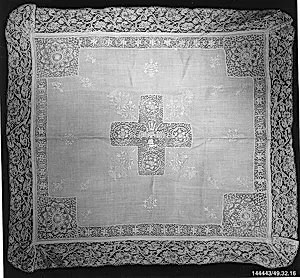
This exquisite *Cover* from early 17th-century Spain the pinnacle of European lace-making artistry. Crafted by an unknown artisan using embroidered net—a technique where fine threads are meticulously stitched onto a mesh ground to create intricate patterns—this textile measures a generous 37 by 35 inches (94 x 88.9 cm). Housed in the Metropolitan Museum of Art's Department of European Sculpture and Decor Arts, it exemplifies the classification of Textiles-Laces, highlighting the era's obsession with delicate, ornamental fabrics. In the Baroque age, Spanish lace was among Europe's finest, often produced in convents or by skilled workshops in regions like Catalonia and Andalusia. Embroidered net allowed for elaborate motifs—likely floral, geometric, or symbolic designs—that demanded extraordinary patience and precision, transforming simple mesh into luxurious coverings for altars, beds, or furniture. These pieces were status symbols for nobility and clergy, blending piety with opulence during Spain's Golden Age under the Habsburgs. Though its exact use remains a mystery, this anonymously gifted treasure (1949) invites us to marvel at the anonymous hands behind it. Its survival speaks to the enduring allure of Spanish textile mastery, a testament to craftsmanship that rivaled painting in its complexity and beauty.