
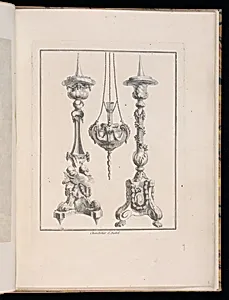
Chandelier d’Autel
Classification
Department
Smithsonian Collection
Museum
Smithsonian American Art Museum
Credit
Purchased for the Museum by the Advisory Council
Accession Number
1921-6-432-7
Rights
Public Domain
About this artwork
Research in Progress
Art Historical Context
**Chandelier d’Aut** *Clément Pierre MarillierFrench, 1740–1808), 1763* *Print; Smithsonian American Art Museum, Smithsonian Collection* Created in 1763 by Clément Pierre Marillier, a skilled French engraver and designer during the lavish Louis XV era, *Chandelier d’Autel* (“Altar Chandelier”) captures the ornate world of 18th-century arts. Marillier specialized in intricate illustrations for books, furniture, and liturgical objects, blending Rococo exuberance—think scrolling motifs and gilded flourishes—with hints of the emerging Neoclassical simplicity. As a print, this work likely served as a model sheet, allowing artisans across Europe to replicate its elegant chandelier design for church altars, a nod to the era’s fusion of faith, fashion, and craftsmanship. Prints like this were revolutionary tools for spreading high-style designs, democratizing luxury in an age before photography. Marillier’s precise engraving technique ensured every curve and candleholder could be faithfully copied by goldsmiths and silversmiths. Though research continues, its presence in the Smithsonian American Art Museum—purchased by the Advisory Council—bridges French elegance with American collecting tastes, underscoring transatlantic artistic exchanges in the Enlightenment. (178 words)