
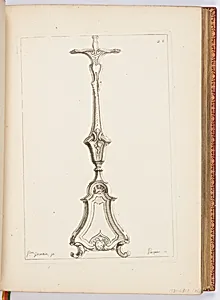
Chandelier d'autel
Classification
Department
Smithsonian Collection
Museum
Smithsonian American Art Museum
Credit
Purchased for the Museum by the Advisory Council
Accession Number
1921-6-313-26
Rights
Public Domain
About this artwork
Research in Progress
Art Historical Context
**Chandelier d'autel (Altar Chandelier)** *Pierre Germain (French, 1703–1783), 1748* *Print; Smithsonian American Art Museum* Germain, a masterful French engraver and designer the Rococo era, created this print in 1748, capturing the opulent spirit of mid-18th-century France. Known for his intricate designs of liturgical silver and ornamental metalwork, Germain often produced detailed engravings that served as blueprints for luxury church furnishings. "Chandelier d'autel" likely depicts an elegant altar chandelier, a symbol of divine illumination in grand cathedrals, blending artistic finesse with religious devotion during the lavish reign of Louis XV. As a print, this work highlights the technical prowess of engraving, a medium that allowed precise reproduction of elaborate motifs—scrolling foliage, radiant candle arms, and gilded flourishes typical of Rococo exuberance. These designs influenced goldsmiths across Europe, bridging art and craftsmanship. Acquired by the Smithsonian American Art Museum through its Advisory Council, it reflects the transatlantic appreciation for French decorative arts, even as research into its exact techniques continues. Visitors will appreciate how Germain's vision evokes the candlelit glow of Versailles-era worship, a testament to an age where beauty elevated the sacred. (198 words)