
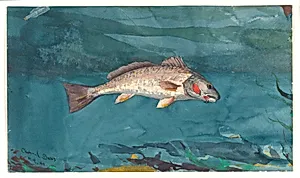
Channel Bass
1904
Medium
Watercolor and graphite on white wove paper
Dimensions
11 1/4 x 19 3/8 in. (28.6 x 49.2 cm) Framed: 24 1/2 x 30 1/2 in. (62.2 x 77.5 cm)
Classification
Watercolor
Culture
American
Department
The American Wing
Museum
Metropolitan Museum of Art, New York, NY
Credit
George A. Hearn Fund, 1952
Accession Number
52.155
Rights
Public Domain
Tags
Art Historical Context
Winslow Homer's *Channel Bass* (1904) is a captivating watercolor and graphite work on white wove paper, measuring 11¼ × 19⅜ inches, now housed in The Metropolitan Museum of Art's American Wing. Created late in the artist's life, it exemplifies Homer's mastery of watercolor—a medium he embraced passionately from the 1870s onward, producing luminous scenes of the American coast that captured the raw power of nature. Homer, a towering figure in American realism, spent his final decades at his Prouts Neck, Maine studio, where he depicted fishermen, the sea, and marine life with unflinching honesty. Here, the title evokes the channel bass (a large red drum fish prized by anglers), likely rendered in Homer's signature style: bold, fluid strokes that convey light dancing on water, the tension of the catch, and the elemental struggle between man and sea. His use of graphite adds precise contours, enhancing the spontaneity of watercolor's transparency. This piece highlights early 20th-century American fascination with outdoor pursuits and self-reliance, reflecting cultural ideals of rugged individualism. Acquired through the George A. Hearn Fund in 1952, *Channel Bass* invites visitors to ponder Homer's enduring legacy as a chronicler of America's wild frontiers.
About the Artist
Winslow Homer · 1836–1910
Winslow Homer (1836-1910) was one of America's greatest painters and a preeminent figure in 19th-century American art. Largely self-taught, Homer began his career as a commercial illustrator and Civil War correspondent for Harper's Weekly before becoming renowned for his powerful marine subjects and landscape paintings. His mastery of both oil and watercolor, combined with his uncompromising reali...