
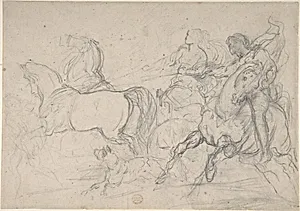
Charioteer and Horseman
1791–1824
Medium
Graphite on light gray paper
Dimensions
8 x 11 1/2 in. (20.3 x 29.2 cm)
Classification
Drawings
Department
Drawings and Prints
Museum
Metropolitan Museum of Art, New York, NY
Credit
Rogers Fund, 1909
Accession Number
10.45.18
Rights
Public Domain
Tags
Art Historical Context
Théodore Géricault *Charioteer and Horseman* (ca. 1817–1824) captures the raw energy of classical antiquity reimagined through a Romantic lens. Created during the artist's short but brilliant career (1791–1824), this graphite drawing on light gray paper showcases Géricault's obsession with horses and human figures in motion—hallmarks of his style. A leading figure in French Romanticism, Géric drew inspiration from ancient Greek sculpture and equestrian scenes, blending dramatic tension with anatomical precision, as seen in his masterpieces like *The Raft of the Medusa*. Rendered on a modest 8 x 11½-inch sheet, the work exemplifies Géricault's masterful use of graphite to build form and shadow. The light gray paper enhances tonal contrasts, allowing the charioteer and horseman to emerge with lifelike vigor against a subtle ground. Such studies were vital to Romantic artists, serving as preparatory sketches that explored movement and emotion, bridging classical heroism with modern intensity. Acquired by The Metropolitan Museum of Art via the Rogers Fund in 1909, this drawing invites visitors to appreciate Géricault's technical prowess and his enduring fascination with the bond between man and horse, evoking the thunder of ancient races in a quiet, intimate format.
About the Artist
Théodore Gericault · 1791–1824
Théodore Géricault, born Jean-Louis André Théodore Géricault on September 26, 1791, in Rouen, France, into a prosperous family—his father a lawyer turned tobacco merchant and his mother from a line of growers—moved to Paris around 1797. Displaying early artistic promise, recognized by painter Jean-Louis Laneuville, he began formal training in 1808 under Carle Vernet, mastering English sporting art...