
Charlatan
1734 - 1780
Medium
etching
Dimensions
108; 80
Rights
Public Domain
About this artwork
ets
Art Historical Context
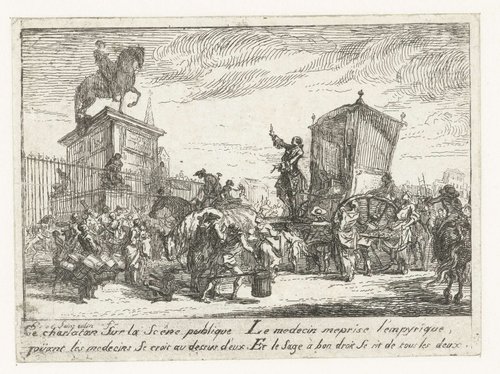
Gabriel Jacques de Saint-Aubin’s etching *Charlatan* offers a compact yet lively glimpse into eighteenth-century French society. Created during the artist’s lifetime (1734–1780), this small print—measuring just 80 by 108 millimeters—reflects the period’s fascination with everyday spectacle and social satire. Saint-Aubin, a keen observer of Parisian life, frequently turned to printmaking to document street performers, vendors, and public gatherings with wit and immediacy. Etching was ideally suited to such subjects. The medium allowed artists to produce affordable, reproducible images that circulated widely among collectors and the public, bridging fine art and popular culture. The intimate scale of this work encourages close looking, rewarding viewers with delicate lines that capture gesture and expression in a single, animated scene. Titled *Charlatan*, the print likely portrays a mountebank or quack doctor, a common figure in Enlightenment-era commentary on deception and credulity. Through this modest yet expressive etching, Saint-Aubin invites modern audiences to consider the enduring theater of public persuasion.
About the Artist
Gabriel Jacques de Saint-Aubin · 1724–1780
Gabriel Jacques de Saint-Aubin (14 April 1724 – 14 February 1780) was born in Paris into an artistic family — one of fourteen children of the court embroiderer and engraver G.-G. de Saint-Aubin. Art ran deep in the family: his brothers Charles Germain and Augustin de Saint-Aubin were also accomplished artists. Gabriel received his earliest training at home before entering the studios of Étienne Je...