
Charles de Cossé (1506–1563), Comte de Brissac
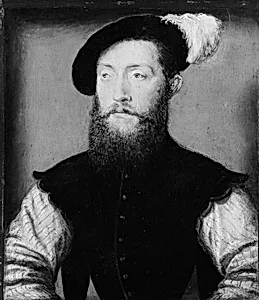
Medium
Oil on wood
Dimensions
6 1/2 x 5 1/2 in. (16.5 x 14 cm); with added strips, 8 1/2 x 6 in. (21.6 x 15.2 cm)
Classification
Paintings
Department
European Paintings
Museum
Metropolitan Museum of Art, New York, NY
Credit
The Jules Bache Collection, 1949
Accession Number
49.7.44
Rights
Public Domain
Tags
Art Historical Context
This intimate portrait by Corneille de Lyon Charles de Cossé, de Brissac (6–1563), a prominent French nobleman and military who rose to become Marshal of France. Painted in oil on wood, the small panel—originally just 6½ x 5½ inches—exemplifies the artist's specialty in miniature portraits of the French elite during the Renaissance. The addition of strips around the edges suggests later alterations to enlarge the frame, a common for such delicate works. Corneille Lyon, a Netherland painter active in Lyon, France, from the 1530s to 1570s, drew from Flemish traditions, producing highly detailed, enamel-like likenesses with sharp focus on faces and subtle modeling. His style bridged Northern realism and Italian Renaissance influences, making these portraits prized possessions for patrons at the courts of Francis I and Henry II. As part of The Jules Bache Collection at The Metropolitan Museum of Art, this piece offers a window into 16th-century French aristocracy amid the Italian Wars, where Brissac distinguished himself as a strategist and governor of Piedmont. Its modest scale underscores the personal nature of Renaissance portraiture, blending historical gravitas with exquisite technical finesse.
About the Artist
Corneille de Lyon · 1533–1575
Corneille de Lyon, born around 1500 in The Hague in the Netherlands, emerged as one of the premier portraitists of the French Renaissance after settling in Lyon by 1533. A Netherlandish artist who became naturalized as a French citizen in 1547, he quickly rose in prominence, serving as official painter to the Dauphin (later Henry II) from around 1540 and continuing under Henry II and Charles IX as...