
Charles de Valois, duc d'Angouleme
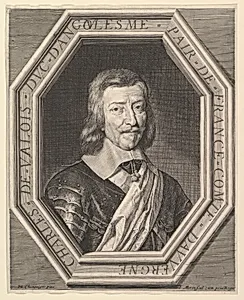
Medium
Etching
Dimensions
image: 11 13/16 x 9 7/16 in. (30 x 24 cm)
Classification
Prints
Department
Drawings and Prints
Museum
Metropolitan Museum of Art, New York, NY
Credit
Harris Brisbane Dick Fund, 1928
Accession Number
28.97.95
Rights
Public Domain
Tags
Art Historical Context
This etching portrays Charles de Valois, Duke of Angoulême (1573–1650), a prominent French nobleman and illegitimate son of King Charles IX. Born amid the religious upheavals of the Wars of Religion, he navigated the turbulent politics of the French court, serving as a military leader and diplomat under kings Henry IV and Louis XIII. The portrait captures his dignified presence, emblematic of the aristocratic elite whose likenesses were avidly collected and disseminated in 17th-century Europe. Created by engraver Jean Morin after a painting by Philippe de Champaigne, a leading Flemish-born Baroque artist renowned for his precise, psychologically penetrating portraits, this work exemplifies the collaborative artistry of the period. Champaigne's style, with its sober realism and subtle modeling, translates beautifully into Morin's etching technique—a revolutionary printmaking method using acid to bite intricate lines into metal plates, allowing for rich tonal depth and widespread reproduction of elite imagery. Measuring 11 13/16 x 9 7/16 inches, this print from the Metropolitan Museum of Art's Drawings and Prints collection (acquired via the Harris Brisbane Dick Fund in 1928) highlights etching's role in democratizing access to royal portraits, bridging courtly splendor with public appreciation. A testament to France's artistic golden age, it invites us to ponder the enduring power of a noble gaze across centuries.
About the Artist
Jean Morin|Philippe de Champaigne · 1605–1650
Jean Morin (c. 1605–1650) was one of the most accomplished French engravers of the seventeenth century, a master of the portrait print whose work stands among the finest examples of French graphic art in its era. Little is known about his early life or training, though his technique suggests exposure to both French and Flemish engraving traditions, the latter being the dominant force in European p...