
Charles Maurin
Medium
drypoint
Classification
Portfolio
Department
CG-E
Museum
National Gallery of Art, Washington, D.C.
Credit
Rosenwald Collection
Accession Number
1953.6.131
Rights
Public Domain
Art Historical Context
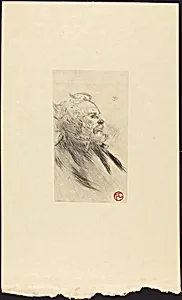
Henri de Toulouse-Lautrec created this drypoint portrait of fellow artist Charles Maurin in 1898, capturing a moment of artistic camaraderie during the vibrant fin-de-siècle period in Paris. As a leading figure of the Post-Impressionist movement, Toulouse-Lautrec was renowned for his incisive depictions of modern life often rendered through innovative printmaking techniques that bridged fine art and popular culture. The choice of drypoint, an intaglio process in which the artist scratches directly into a metal plate to produce rich, velvety lines from the raised burr, highlights Toulouse-Lautrec’s mastery of graphic media. This work belongs to a portfolio in the National Gallery of Art’s Rosenwald Collection, underscoring its place within the museum’s distinguished holdings of prints and drawings that trace the evolution of European printmaking. Toulouse-Lautrec’s portraits of contemporaries like Maurin offer intimate glimpses into the interconnected world of late-19th-century artists, where technical experimentation and personal relationships shaped the era’s creative output. The print’s restrained yet expressive line work reflects the artist’s ability to convey personality and mood with economical means.
About the Artist
Henri de Toulouse-Lautrec · 1864–1901
Henri Marie Raymond de Toulouse-Lautrec-Montfa (1864-1901) was a French Post-Impressionist painter, printmaker, and illustrator whose innovative poster designs revolutionized graphic art and advertising in late 19th-century Paris. Born into an aristocratic family at Albi in southern France, Toulouse-Lautrec's privileged lineage traced back to the Counts of Toulouse and extended uninterrupted to th...