
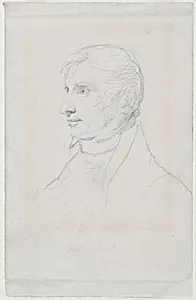
Charles Stewart
Medium
Drawing
Classification
Drawing
Department
Smithsonian Collection
Museum
Smithsonian American Art Museum
Credit
National Portrait Gallery, Smithsonian Institution
Accession Number
NPG.71.17
Rights
Public Domain
Tags
Art Historical Context
In the Smithsonian American Art Museum's collection, Thomas Sully's 1817 drawing *Charles Stewart* captures the dignified likeness of Commodore Charles Stewart, a celebrated U.S. Navy officer. Sully (1783–1872), a leading American portraitist influenced by British Romantics like Sir Joshua Reynolds, was renowned for his fluid, expressive style that brought sitters to life with graceful poise and emotional depth. This work, housed in the National Portrait Gallery, exemplifies his preparatory drawings—often in pencil or chalk—that served as studies for larger oil portraits, showcasing his masterful handling of light, shadow, and subtle facial nuances. Completed just two years after the War of 1812, the drawing honors Stewart's heroism, including his daring capture of British ships HMS *Cyane* and *Levant* aboard the USS *Constitution*. For this feat, Congress awarded him the prestigious Congressional Gold Medal in 1816, symbolizing national pride in the young republic's naval triumphs. As a portrait of a military leader, it reflects early 19th-century America's fascination with heroic figures who embodied republican virtues. Sully's economical yet evocative technique in this medium highlights the intimacy of drawing, allowing for quick yet insightful character studies amid his busy Philadelphia studio. Visitors will appreciate how this modest sketch immortalizes a pivotal moment in American maritime history.