
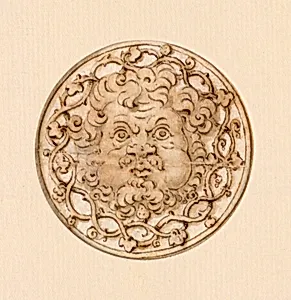
Chased Silver Medallion
Classification
ornament
Department
Smithsonian Collection
Museum
Smithsonian American Art Museum
Credit
Gift of Gramercy Park Foundation, Inc.,
Accession Number
1961-18-1
Rights
Public Domain
About this artwork
Research in Progress
Art Historical Context
Created by Hans Holbein the Younger during his final decade in England, this chased silver medallion reflects the artist’s remarkable range beyond portraiture. Best known for his precise and psychologically penetrating paintings of Tudor courtiers, Holbein also supplied elegant designs for goldsmiths and metalworkers serving Henry VIII’s court. The medallion’s classification as an ornament suggests it was intended as a wearable or display piece, blending personal adornment with the refined visual language of Renaissance humanism. Although the exact technique and imagery remain under study, the chased surface would have required skilled hammering and engraving to create raised patterns on the silver. Such objects were prized not only for their material value but also for the prestige of Holbein’s inventive motifs, which often incorporated classical figures, heraldic elements, or intricate strapwork. Now part of the Smithsonian American Art Museum’s collection through the generosity of the Gramercy Park Foundation, the medallion offers visitors a glimpse into the collaborative world of 16th-century court art, where painters, goldsmiths, and patrons together shaped the visual culture of the Tudor era. Research continues to illuminate its specific history and craftsmanship.