
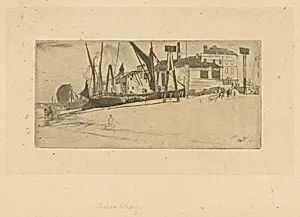
Chelsea Wharf
Classification
Department
Smithsonian Collection
Museum
Smithsonian American Art Museum
Credit
Gift of Charles Lang Freer
Accession Number
F1905.163
Rights
Public Domain
Tags
About this artwork
2, 2
Art Historical Context
James McNeill Whistler’s *Chelsea Wharf* (1863) captures the bustling riverside life along London’s Thames, a motif central to the artist’s celebrated “Thames Set” of etchings. Born in America but a longtime London resident, Whistler (1834–3) immersed himself in the Chelsea neighborhood during the 1860s, drawing inspiration from its working wharves, boats, and misty atmospheres. This print reflects his early mastery of printmaking, blending Realism with a poetic subtlety influenced by Japanese art and French etchers like Félix Buhot. As an etching—a meticulous intaglio process where acid etches lines into a metal plate—*Chelsea Wharf* showcases Whistler’s precision and tonal range, evoking the play of light on water and the grit of industrial London. Created amid rapid urban change during the Victorian era, it preserves ephemeral scenes of dockworkers and vessels, highlighting Whistler’s belief in “art for art’s sake” over narrative detail. A prized gift from industrialist Charles Lang Freer to the Smithsonian American Art Museum, this work anchors Whistler’s legacy in American collections, bridging U.S. and European traditions. Visitors will appreciate its quiet drama, a window into 19th-century Thames life.