
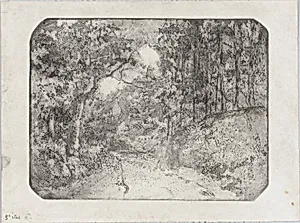
Chemin sous bois à Pontoise
1879
Medium
Aquatint and etching
Dimensions
Plate: 6 1/4 × 8 1/2 in. (15.9 × 21.6 cm)
Classification
Prints
Department
Drawings and Prints
Museum
Metropolitan Museum of Art, New York, NY
Credit
Purchase, Charles and Jessie Price Gift, 2017
Accession Number
2017.123
Rights
Public Domain
Tags
Art Historical Context
Step into the serene woodlands of 19th-century France with Camille Pissarro's *Chemin sous bois à Pise* (1879), a aquatint and etching a shaded path winding through dense trees. Pissarro, a founding father of Impressionism, spent much of the 1870s in the rural village of Pontoise northwest of Paris, where he painted and printed everyday landscapes to evoke the fleeting effects of light and atmosphere. work reflects his deep affinity for the French countryside, transforming a simple forest trail into a study of dappled sunlight and natural textures. Printed in aquatint—a technique Pissarro mastered for its soft, painterly tones resembling watercolor—combined with precise etching lines, the piece showcases his innovative approach to printmaking. Unlike traditional engravings, aquatint allowed Impressionists like Pissarro to mimic the luminosity and spontaneity of oil paintings on paper, making fine art more accessible during a time when exhibitions and reproductions were revolutionizing the art market. Housed in the Metropolitan Museum of Art's Drawings and Prints department (acquired in 2017 through the Charles and Jessie Price Gift), this 6 1/4 × 8 1/2-inch gem invites visitors to appreciate Pissarro's bridge between painting and print, highlighting the harmonious beauty of untamed forests amid France's industrializing era.
About the Artist
Camille Pissarro · 1831–1903
Camille Pissarro (1830-1903) stands as the patriarch of Impressionism, the only artist to exhibit in all eight Impressionist exhibitions and a mentor whose influence shaped the trajectory of modern art. Born Jacob Abraham Camille Pissarro on the Caribbean island of St. Thomas to a Jewish-Portuguese merchant family, he abandoned the family business to pursue painting, eventually settling in Paris i...