
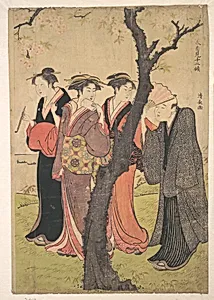
Cherry Blosson Viewing at Gotenyama
ca. 1784
Medium
Woodblock print; ink and color on paper
Dimensions
14 11/16 x 10 1/8 in. (37.3 x 25.7 cm)
Classification
Prints
Culture & Period
Japan · Edo period (1615–1868)
Department
Asian Art
Museum
Metropolitan Museum of Art, New York, NY
Credit
Rogers Fund, 1914
Accession Number
JP129
Rights
Public Domain
Tags
Art Historical Context
Step into the vibrant world of Edo-period Japan with Torii Kiyonaga's *Cherry Blossom Viewing at Gotenyama* (ca. 1784), a captivating woodblock print from the ukiyo-e tradition, or "pictures of the floating world." This ink and color on paper artwork, measuring about 15 x 10 inches, depicts elegant men and women gathered amid blooming cherry trees on Gotenyama hill in Edo (modern Tokyo), a famed spot for hanami—Japan's cherished springtime ritual of flower viewing. The fan-shaped format, known as uchiwa-e, adds an intimate, handheld charm, evoking souvenirs carried to picnics. Kiyonaga, a master of the Torii school renowned for bijin-ga (images of beautiful women), excels here in his refined style: graceful figures with flowing robes, subtle perspective, and harmonious compositions that capture fleeting beauty. Woodblock printing allowed such prints to be produced affordably, democratizing art for urban pleasure-seekers during the prosperous Edo period (1615–1868). Cherry blossoms symbolize life's transience in Japanese culture, making this scene a poignant celebration of joy amid impermanence. Held in the Metropolitan Museum of Art's Asian Art collection (Rogers Fund, 1914), this print invites you to savor the delicate interplay of pink petals, silk fans, and human connection—a timeless snapshot of refined leisure.
About the Artist
Torii Kiyonaga · 1752–1815
Torii Kiyonaga, born Sekiguchi Shinsuke in 1752 in Uraga, Sagami Province, was the son of an Edo bookseller who owned tenements near a bustling fish market. At age 14 in 1765, he began his apprenticeship under Torii Kiyomitsu, the third-generation head of the prestigious Torii school of ukiyo-e, renowned for kabuki theater illustrations and signage. Adopted into the Torii family, Kiyonaga succeede...