
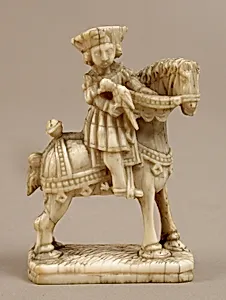
Chess Piece in the Form of a Knight
Unknown Artist
ca. 1500
Medium
Elephant ivory
Dimensions
Overall: 2 13/16 x 1 7/8 x 15/16 in. (7.2 x 4.8 x 2.4 cm)
Classification
Ivories-Elephant
Culture
Netherlandish
Department
Medieval Art
Museum
Metropolitan Museum of Art, New York, NY
Credit
Pfeiffer Fund, 1984
Accession Number
1984.214
Rights
Public Domain
Tags
Art Historical Context
This delicate chess piece, carved from elephant ivory around 1500 in the Netherlands, captures a knight mounted on horseback in miniature form. Standing just under three inches tall, it exemplifies the refined craftsmanship of late medieval ivories, where functional game pieces doubled as objects of prestige. Created during a period when chess enjoyed widespread popularity among European nobility, the knight figure reflects the era’s chivalric ideals and the strategic importance of mounted warriors in both warfare and courtly culture. Ivory’s smooth, luminous surface allowed artisans to achieve intricate details despite the object’s small scale, highlighting the technical skill required to carve such works by hand. As a luxury material sourced from distant trade routes, elephant ivory underscored the wealth and international connections of its original owners. Netherlandish workshops were renowned for producing finely detailed ivories that blended functionality with artistic expression. Today housed in the Metropolitan Museum of Art’s collection of medieval art, this chess piece offers a tangible glimpse into the leisure and artistry of the late Middle Ages. Its survival speaks to the enduring appeal of both the game and the masterful carving traditions of the period.