
Mirror Case
Unknown Artist
1350–75
Medium
Elephant ivory
Dimensions
Overall: 4 3/8 x 4 1/8 x 7/16 in. (11.1 x 10.4 x 1.1 cm) diameter: 4 in. (10.1 cm)
Classification
Ivories-Elephant
Culture
French
Department
Medieval Art
Museum
Metropolitan Museum of Art, New York, NY
Credit
Gift of George Blumenthal, 1941
Accession Number
41.100.160
Rights
Public Domain
Tags
Art Historical Context
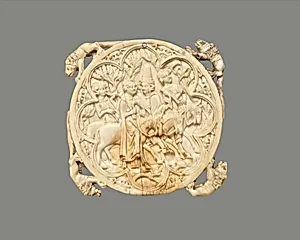
This exquisite **Mirror Case** from 1350–75 exemplifies the artistry of late medieval French ivory carving. Crafted from elephant ivory—a rare and luxurious material imported from Africa and Asia—this small, circular object (4 inches in diameter) served as the ornate back for a handheld mirror popular among the nobility. Produced in Parisian workshops during the Gothic era, such ivories were status symbols, blending fine craftsmanship with secular themes amid a predominantly religious art world. Theately carved relief depicts a courtly scene featuring men and women, horses, lions, and falcons—evoking chivalric hunts, romances, or tournaments central to 14th-century French culture. Lions might symbolize strength or nobility, while falcons suggest falconry, a elite pastime. The artist's unknown hand showcases virtuoso techniques: shallow undercutting for depth, polished surfaces for a luminous glow, and dynamic compositions that wrap around the round form, drawing the viewer into the narrative. Housed in The Metropolitan Museum of Art's Medieval Art department (gift of George Blumenthal, 1941), this piece highlights the era's commercial ivory trade and the rise of portable, personal luxury goods. It offers a glimpse into the vibrant, worldly lives of medieval elites, where beauty and storytelling met in miniature splendor.